The Band in the Bank Vault
by Timothy Lord
In the early days of punk rock I auditioned for a band in an empty bank vault beneath a Taco Bell near the corner of 7th and Hennepin in downtown Minneapolis. I doubt the bank vault and the Taco Bell, which shared an outer entrance from the street, are still there. The block next to them, Hennepin Avenue between 6th and 7th Streets—E block, it’s called— was demolished and redeveloped. Before it was razed it was the city’s sleaze street. The American Empress peep show palace, Hot Licks record store, the Rifle Sport arcade, Moby Dick’s bar, all bookended by the two Shinders newsstands with everything from classic literature to porn. Out on the sidewalk the homeless idled, dealers loitered, and hookers paraded in acrid cigarette smoke. I loved the drama in the evening when the street preachers arrived, foretelling the end times. The band I tried out for was called The Sensational SOBs.
Before The SOBs I auditioned on bass guitar for a bunch of other bands. I drove up to the northern suburbs in a foot of dirty snow, some awful 60s subdivision with about a million split levels, to try out for a group that was playing Damned covers with no singer, just blasting away instrumentally. Then I played with a singer/guitarist who thought he was the next mod superstar, but didn’t have the voice, guitar chops, looks, or clothes to pull it off. My tastes tended toward punkier music, and I succeeded in putting together a hardcore trio with a guitarist and drummer. They proved more interested in smoking pot, though, than writing or learning songs. I wrote a few short, fast, thrashy things, but gave up because we could never get past the pot smoking to the song learning. Then I messed around with a few different guitarists. One later sang for a band named Also Sprach. Another, an indigenous guy from Bemidji, made a name in record production after a short stint playing second guitar for King-Sized Condom Ripper. All these endeavors burned out and died like an aging punk rocker.
I felt like a real failure and was wondering if I should move back to the small town I came from. I had a job, but a lousy one. It was draining my energy, and I didn’t know how long I could stick with it. I had thought of hunting for a better one, but jobs were scarce. Unemployment was in double digits, the highest it had been since the Great Depression. So when the guitarist of The Sensational SOBs, Sam, told me they thought I might be a good fit, I was ecstatic. He didn’t tell me where they rehearsed. He just set a day and time and told me to meet him at the Taco Bell near the corner of 7th and Hennepin.
The Sensational SOBs had previously been called The Posers, and their set contained both revved up 60s classics and a similar type of original music. I wasn’t excited about performing a lot of covers, and I really wanted to play the kind of hardcore punk that I was going out regularly to listen to in the clubs. Thus, I had some misgivings about committing to this kind of band. Would I feel like a money-grubbing sell-out? Still, like a lot of my friends in the scene, I was not keen on having to work a day job. The SOBs had a huge following and gigged around town a lot, and if I landed the spot I thought it was possible I might be able to quit the little café where I was doing food prep.
On the Saturday of the audition, all tense and on edge from nerves, I bussed downtown to the IDS tower and trudged through snow and slush to Hennepin. I browsed the books and magazines at the two Shinders newsstands and riffled through records at Hot Licks, but I couldn’t concentrate on much of anything. If I’d had more time, I might have tried to relax by playing a little pinball at the arcade.
Near the appointed time I drifted down to the Taco Bell to wait for Sam. It was cold, but the air was calm. He arrived, with his jacket collar up, no coat, and smoking. He was dark and swarthy, but not in a tough guy kind of way, looking more like a librarian or an accountant. We entered a long, broad hallway and tramped icy shoes toward some stairs at the end of it. Sam led me down the stairs and around a couple corners where we arrived at the door of a bank vault. Its door was open, and I could hear a drummer warming up inside.
As torn and conflicted as I was about the audition, I was also agitated as hell about it. I had showed up to make an impression, and my heart was thumping far faster than the drum beats coming from the vault. When I saw the thick door of the bank vault and realized that’s where the SOBs practiced, I swear it must have zoomed up to coronary levels. I’m claustrophobic, and I’d never considered they’d be rehearsing underground in some airtight space. I was unsure what to think about this development.
Inside the vault the walls were bare, the space tight. I said hello to the drummer, Johnny, with his fedora, who I saw regularly at punk shows. He was a friendly guy, and I loved the Union Jack shirt he often wore. But he had this fetish for women’s hair he was always too willing to carry on about. I can understand the sexual attraction for women’s hair, especially back in that blow-dried, glamor hair era, but he just got too graphic for my comfort.
The singer, Ed, introduced himself and we started right away, real businesslike. He was really something else, with the stature of a pro wrestler rather than a rock n’ roll singer. He had a long floppy cowlick and would pick up the mic stand and slam it into the floor now and then. When he really belted out the lyrics his stomach rippled up and down like ocean waves. Every time Sam began a solo, Big Ed would take the mic off the mic stand and swing it like a lasso. We were tearing through a hepped-up cover of “Just Like Me” by Paul Revere & the Raiders when the mic whizzed by me just two inches over my head. I had to keep one eye on him all the time. Given the band whose song we were playing, I couldn’t help thinking that if that mic hit me it was going to feel like getting walloped by the butt of a Redcoat’s musket. And then there was the mic stand bashing into the floor, which startled the hell out of me. But mainly there was the bank vault, and I felt like I always had to watch that heavy door of the vault. I couldn’t concentrate on my fretboard. I imagined a pissed off ex-band member, the old bass player maybe, coming along to shut us in till we all suffocated.
We banged through a couple more covers and they taught me one of the more straightforward SOB tunes. They said they liked my playing and Ed seemed to like me well enough. He tore a large bite out of a pungent bean burrito and pushed his cowlick out of his eyes. With his hands on his considerable hips, he said he’d call me soon if they wanted me.
I wondered how much money used to be stored in that bank vault. I asked Ed if it was their permanent practice space.
He said, yeah, they loved it for its central location and the weirdness of it.
“Oh, and if you don’t mind me asking, what happened to your old bass player?” I asked this in an offhand manner as I was packing up my gear, trying to make it sound as natural as I could.
“Drugs. He got unpredictable. We had to boot him.”
Oh, great.
Day by day I became more panicked about being an SOB. Sometimes I found myself short of breath for no apparent reason. I started to think about looking for a new job, maybe placing an ad—Bass Player Looking for Punk Band—in the newspaper. When I answered the telephone a couple weeks later and heard Big Ed’s voice, I almost dropped the phone. My legs buckled, and I sank down to the floor.
He said The SOBs had finally hired a bass player. “I’m sorry it wasn’t you, but I wanted you to know that you were a close second choice. It was a tough call.”
Up to that point, I hadn’t been a very competitive musician. Yet I realized I was miffed that they’d found a better bassist than I. After hanging up I wondered why they’d picked someone else, and why I had come up short. Was I too erratic? Tended to rush things? Not flashy enough? I thought about being onstage in the clubs, my amplifier’s booming rumble, the affirming applause from the crowd. Perhaps grabbing a check at the end of the night.
Then the bank vault reappeared in my mind’s eye, the constricted space with its massive bulky door. I dropped onto my back and took a few deep gulps of air. Gradually I relaxed and was content for the first time since the audition.
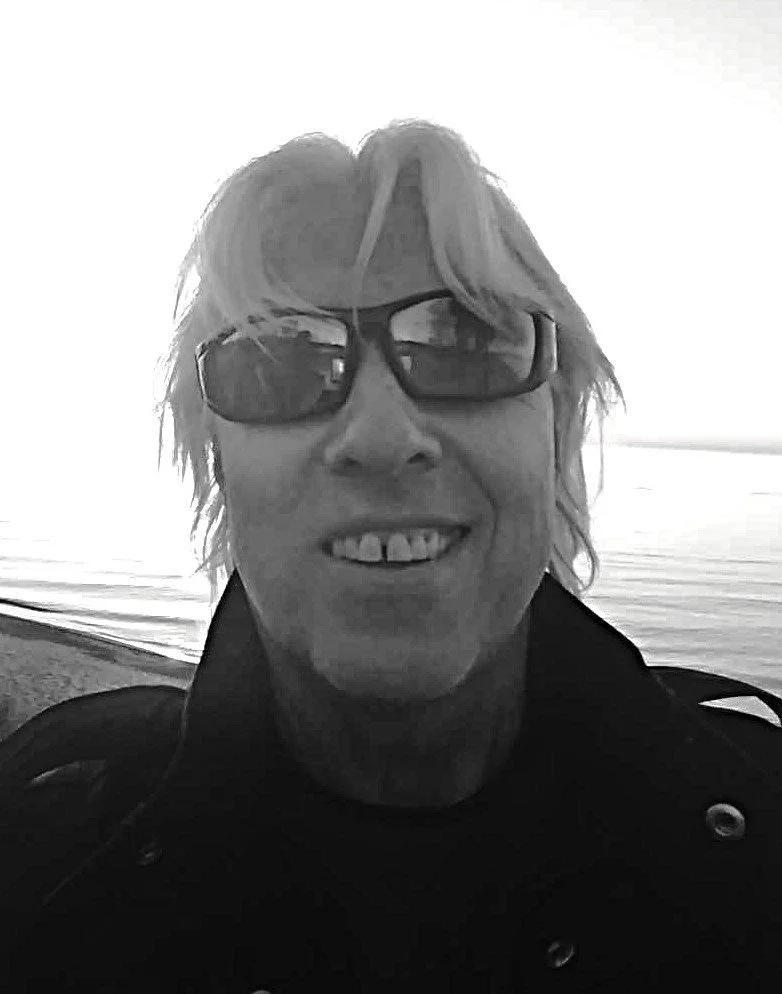
Timothy Lord grew up in Iowa and spent much of his early 20s in Minnesota before moving on to Ohio, Indiana, and Illinois. He has run college track, played in the first hardcore punk band in Iowa, earned an M.A. in English, and, more recently, worked as a college philosophy professor. Besides publishing in philosophy, he has published fiction in Oakwood and criticism in Aethlon. He is currently writing a novel and takes breaks from that to write short fiction and travel around the upper-Midwest, especially Wisconsin and Michigan.
An Interview with Timothy Lord
by Wesley Hazelberg
Timothy Lord wishes to thank the editors of Barstow & Grand for the interview. He had a great time at the release party and reading last November, and found it wonderful to see the sense of community that has been built up around the journal!
Wesley Hazelberg: How did you first begin writing creatively? What are your biggest inspirations?
Timothy Lord: I wrote a little fiction in high school and college, where I majored in English. By my junior year I had decided that I wanted to be a fiction writer, but I also had scholarly interests in literature, so for my M.A. degree I specialized in American literature. Luckily, I found time to squeeze two fiction writing workshops into my program of study. Those were the only graduate school creative writing courses I’ve ever been able to take, and that was forty years ago. I went on to earn a Ph.D. in Literature and Philosophy at the only program of its kind in the country, drifted more toward philosophy, and eventually got a job teaching college philosophy. After publishing a decent amount of writing in academic philosophy journals, I only became a fiction writer when I retired early four years ago and immediately picked up fiction writing again!
I wrote my M.A. thesis about the short fiction of Donald Barthelme, but I don’t write anything like him. My biggest inspiration may be the post-war Italian neo-realists. For about a decade I traveled in Italy quite a bit, among other things researching Italian philosophers. I read everything I could by writers such as Alberto Moravia and Cesare Pavese clear up to Elena Ferrante, sometimes in the original Italian as my language skills improved. I love how those writers rooted their fiction in specific places—Rome, Turin, and Naples in the above examples—and how the characters are developed in relationship to the real places they occupy. As someone who has lived throughout the Midwest, I’m attracted to a lot of Midwestern literature for similar reasons, with some of my favorites being Stuart Dybek’s Chicago stories and Charles Baxter’s Minneapolis work.
WH: What first led you to write “The Band in the Bank Vault”? Are there any particular feelings or themes you associate with your story and/or the process of writing it?
TL: I wrote the first draft of “The Band in the Bank Vault” a few years ago in a class taught by Patricia Ann McNair (a great teacher and another good Midwestern writer) at the Mining Your Stories Writing Retreat in Mineral Point, Wisconsin. When I go to writers’ retreats or conferences, I always keep a mental list of stories and scenes I want to write which can be adapted to particular writing assignments or situations. As I recall, the prompt was to write a scene in which a character feels uncomfortable, and a story about a claustrophobic punk musician auditioning for a band in a bank vault seemed to fit the bill!
Like the writers mentioned above—and perhaps even more so—I’m really interested in how setting, plot, and character interact and how characters can be developed by dramatizing the way they choose to inhabit or stay away from certain places. I wanted to depict that iconic block of Hennepin Avenue adjacent to the Taco Bell as it really was in the early 1980s, but I also wanted to get across the sleazy and seedy feel of the area (now long gone), as well as the narrator’s complete comfort with all that! It’s a place he likes to hang around, consistent with his being a punk musician, but this comfort seems rather incongruous with his unexpected claustrophobia in the bank vault.
WH: What gave you the idea for the rehearsal space in an empty bank vault underneath a Taco Bell? Do you think such a magical location has ever truly existed?
TL: I know such a place existed! I actually rehearsed on bass guitar with a band in the empty bank vault of the historic Lincoln Bank Building on Hennepin Avenue. At the time I intended the story to be set, it wasn’t a Taco Bell on the first floor, though, but a fast-food Mexican local chain restaurant called Zantigo. But I was only sort of mistaken about that, as I’ve recently learned, because a Taco Bell did eventually replace the Zantigo in the late ‘80s.
WH: Are there any real-life experiences you’ve had that helped inform elements of the story, such as the characters or setting?
TL: I lived in Minneapolis for a few years in the early 1980s, and I worked only a couple of blocks from where “The Band in the Bank Vault” is set. The famous club First Avenue is on the other side of the same block as the Lincoln Bank building. I spent a lot of time at First Avenue and even more at the 7th Street Entry club which adjoins it. In between punk bands at the Entry I’d often go browse books and magazines at Shinders, get a Chilito from Zantigo, or watch the action on Hennepin. I also did a lot to help keep Hot Licks Records in business!
As for the characters in the story, certainly many of their behaviors and personality traits are totally imagined. Beyond that, I’ll only say that my fiction often contains elements of the Roman ả clef and of autofiction—although for my own work I may prefer to just use the old term “autobiographical fiction.” My writing is much more like Jay McInerney’s Bright Lights, Big City, which I’ve found to be very influential, than that of autofictionists like Rachel Cusk.
WH: Is there anything in particular you hope audiences take away from your story?
TL: Yes, speaking of McInerney’s novel, I’ve always been a sucker for “young rural type moves to the city (and mayhem ensues)” sorts of narratives, which in America go back at least to Theodore Dreiser’s Sister Carrie(yet another Midwestern writer). Bright Lights, Big City is a yuppie version of that narrative, with a main character set on making some money, buying nice clothes, going dancing, and snorting a lot of cocaine. “The Band in the Bank Vault” is a punk rendition of that narrative—one of a few I’m working on—which depicts a character with very different ideals and provides an alternative story about ambition in the Reagan-era ’80s.
WH: What sort of projects are next for you as a writer?
TL: I have another punk story forthcoming inI-70 Review, and a handful of my stories are circulating through literary journals and reviews. My big project is a novel I’m drafting—which is approaching the halfway mark—that takes place in the early ’80s. It was a decade which, maybe more than any other, was formative for me. Readers who enjoyed “The Band in the Bank Vault” should enjoy the novel as well! It’s definitely a “young rural type moves to the city and mayhem ensues” sort of story, with lots of humor, some non-stereotypical punk characters, and hopefully insightful things to say about the problems we face and the fractured identities we adopt if we choose the difficult path of moving back and forth between seemingly incompatible communities.I can be reached at timothylord82@gmail.com.